A technical field guide to a major standard — researched against the OWASP ASVS 5.0.0 stable release, with my own analysis of its practical and future implications.
OWASP ASVS 5.0.0 was released on 30 May 2025, live at Global AppSec EU in Barcelona. This article is dated 26 October 2026. Keeping those dates separate matters: the standard's publication date is a historical fact; the opportunities and adoption paths I discuss here are my assessment today.
I think the most interesting thing about this release is not any individual security control. It is a shift in what we expect a security requirement to do. We should be able to explain the outcome we need, assign responsibility for achieving it, and demonstrate — with evidence — that it actually works.
That is a much more useful conversation than simply asking whether an application has passed a checklist.
The diagrams are original, schematic illustrations. On smaller screens, scroll them horizontally to inspect the labels.
First, the scale of the change
Version 4.0.3 was released in October 2021. Its successor is a genuine major revision, not a cosmetic refresh. ASVS 5.0.0 contains 345 requirements in 17 chapters, with substantial restructuring and new domains addressing current architectures.
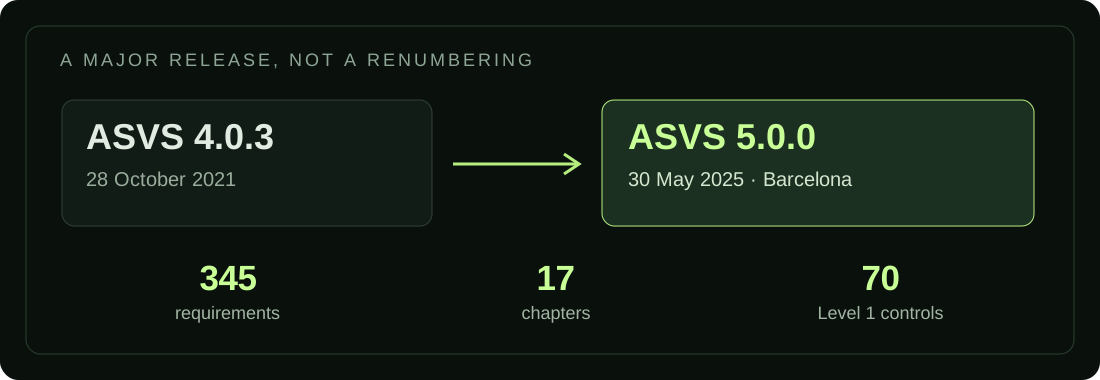
The official migration guidance gives a telling picture: of the 286 requirements in 4.0.3, only 11 remained unchanged, while 15 received grammatical adjustments only. Another 109 are no longer independent requirements: 50 were deleted, 28 eliminated as duplicates and 31 merged with others. The remaining requirements were revised, reorganized or renumbered.
This does not mean 109 protections have suddenly become unnecessary. Merging a duplicate or replacing an overly prescriptive rule with a clearer outcome changes how we verify it; it does not necessarily remove the underlying security need. The lesson for anyone with a 4.0.3 assessment is straightforward: a spreadsheet renumbering exercise is not a 5.0 migration.
The chapters now cover encoding and sanitization; validation and business logic; web frontend security; APIs and web services; file handling; authentication; session management; authorization; self-contained tokens; OAuth and OpenID Connect; cryptography; secure communication; configuration; data protection; secure coding and architecture; security logging and error handling; and WebRTC.
Rather than walk through 345 entries, I want to examine the changes that materially affect how we design, build and assess real systems.
1. From prescribing a mechanism to proving a security outcome
Some older requirements were closely associated with specific technologies or techniques. ASVS 5.0 deliberately prefers security objectives that can be verified, and names a mechanism when that is necessary or useful as an example.
That difference matters more than it first appears. A statement such as “use technology X” can be perfectly implemented while the intended risk remains untreated. An outcome-focused requirement forces us to ask a harder question: what must an attacker be unable to do?
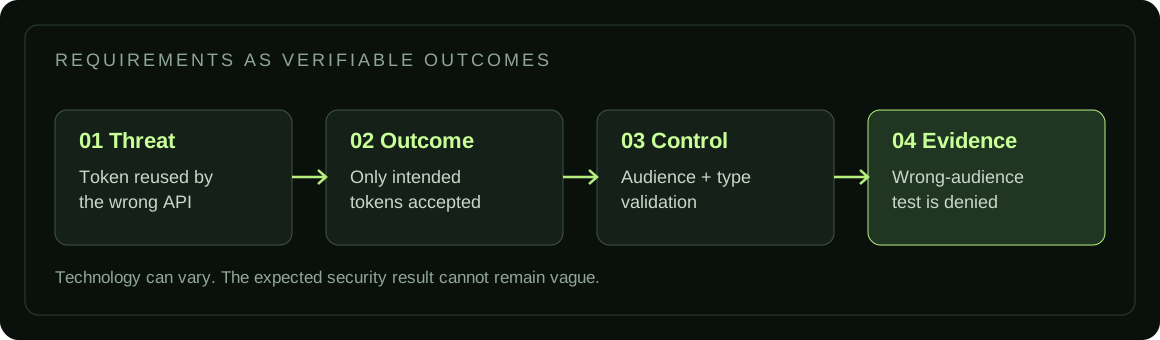
Consider a system that accepts tokens. Choosing a JSON Web Token (JWT) library is an implementation decision, not proof of security. What matters is whether the receiving service verifies the signature, trusts the key source, accepts the intended token type, and checks whether that token was meant for this audience. ASVS 5 explicitly separates these responsibilities in its self-contained tokens chapter.
The benefit: teams retain technical flexibility without losing a measurable security target. The architect records the trust assumptions, the developer chooses a suitable implementation, and the reviewer has something testable to assess.
The caution: outcome-focused language only works if the organization can explain its evidence. “We have implemented strong security” is neither an outcome nor a verification result.
2. A different interpretation of Levels 1, 2 and 3
The change to verification levels is one of the most consequential decisions in the release.
ASVS 4.x described Level 1 as a minimum, Level 2 as standard, and Level 3 as advanced. In practice, this created two problems: the entry level was relatively large, and a team's selected level could be mistaken for a universal risk classification.
ASVS 5.0.0 has 70 Level 1 requirements out of 345 (about 20%). The project's comparison notes that 4.0.3 had 128 Level 1 requirements in its level-classification count. The new model prioritizes meaningful first-layer defenses at Level 1; Level 2 adds broader protection; Level 3 includes additional, often more demanding defenses and depth.
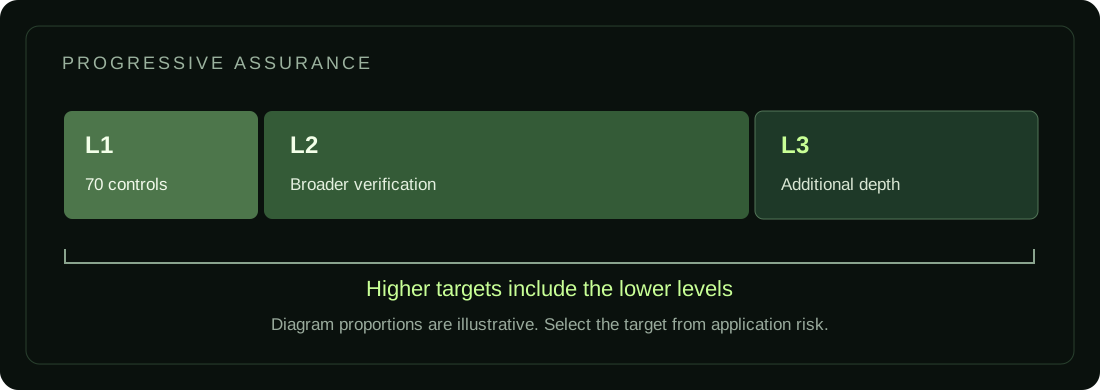
The crucial point is that a lower entry threshold is not permission to accept higher risk. Level 1 makes adoption approachable. For sensitive personal data, regulated services or high-impact operations, it may be an insufficient destination. The target must come from the application context, not from a marketing statement that every system is now “ASVS compliant”.
In my view, the healthiest interpretation is progressive: establish a verifiable baseline, identify the highest-impact gaps and expand coverage intentionally. The choice should be recorded, reviewed and revised as the system changes.
3. Documented security decisions become part of the evidence
ASVS 5 is clearer that certain requirements cannot be assessed properly without knowing what the application was designed to permit. This is an evolution of ideas already present in 4.x, not the invention of architecture documentation from nothing.
Take authorization. A test can show that one user was denied access to one resource. But which roles exist? Can a professional access all records, only assigned records, or only records connected to a justified workflow? If nobody has stated the decision, even a passing test may validate the wrong rule.
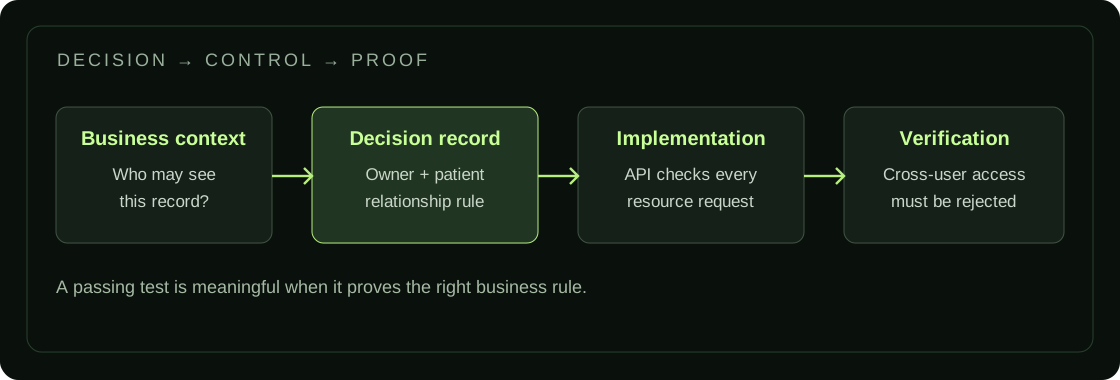
For me, this is where application assurance becomes genuinely useful to architecture teams. A documented decision should capture:
- The asset, operation and business context being protected.
- The caller, trust boundary and permission being evaluated.
- The failure mode considered, including misuse and abnormal conditions.
- The control chosen, its owner and the reason for that choice.
- The evidence needed to establish whether it works.
The benefit: fewer hidden assumptions, faster design reviews, and more meaningful tests. The cost: a little more deliberate work up front. That cost becomes wasted bureaucracy only if the document has no connection to code, policy or test evidence.
4. The browser and the API are different trust domains
Web frontend security has its own chapter, V3. This reflects a modern architectural reality: the browser is an active execution environment, not simply a screen in front of a trustworthy backend.
V3 brings browser-specific protections into a coherent place: cookie attributes, safe handling of content, Content Security Policy (CSP), cross-origin boundaries, protections against forged requests, trusted external resources and related browser controls.
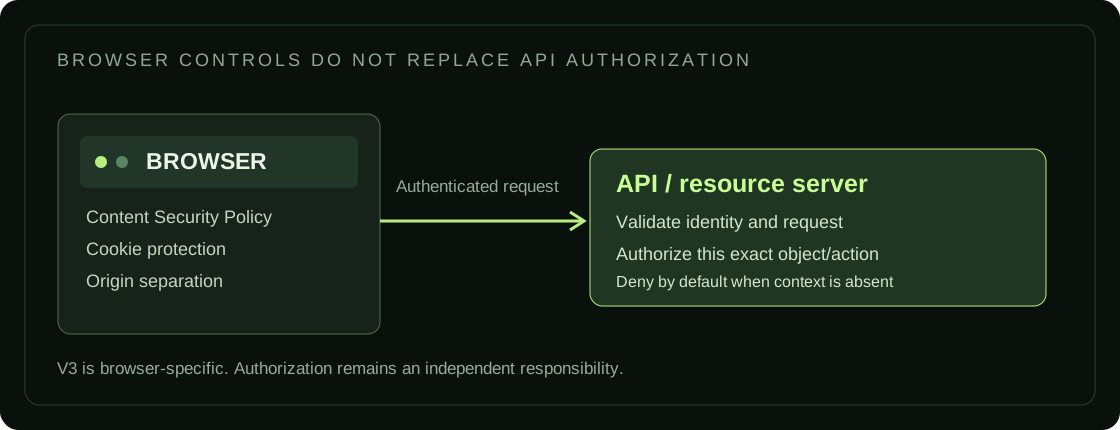
Consider a single-page application that calls an API. A well-configured cookie can help protect a session; CSP can reduce the impact of some script injection paths; strict origins can constrain unwanted browser interactions. But none of these controls grants permission to read an object. The backend must still make the authorization decision.
The benefit of a dedicated browser chapter is clarity: frontend and API responsibilities can be reviewed separately, without assuming that a gateway or an identity provider somehow secures every interaction after login.
It also makes the applicability question explicit: a machine-to-machine API with no browser frontend should not be burdened with browser-only requirements just to achieve a neat percentage in a dashboard.
5. Tokens, OAuth and OpenID Connect are treated as security architecture
Two areas deserve particular attention: V9 Self-contained Tokens and V10 OAuth and OIDC. They are related, but they solve different problems.
V9 is about trusting the contents of a token or assertion: cryptographic integrity, algorithms, trusted key sources, valid time windows, audience and intended purpose. V10 covers OAuth and OpenID Connect roles and flows: clients, resource servers, authorization servers, OpenID providers, consent and token handling across those parties.
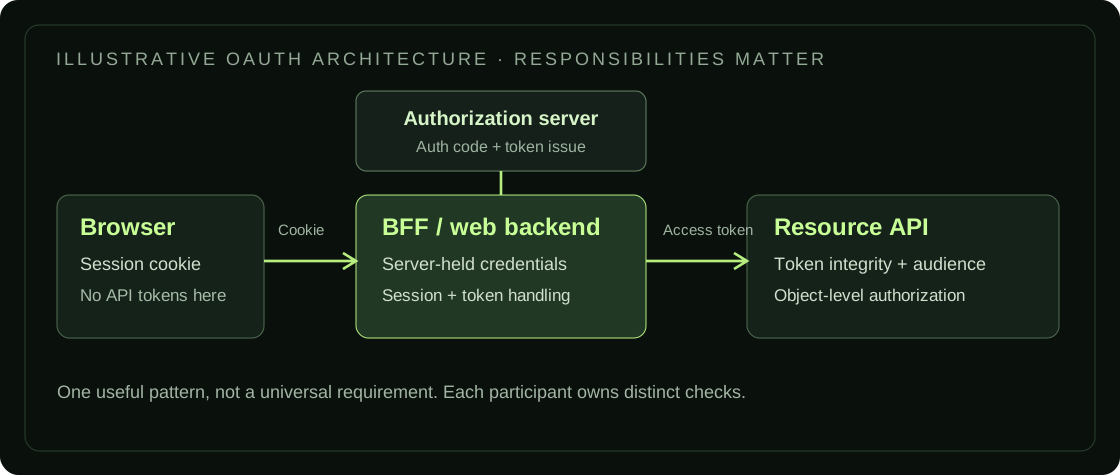
Several concrete controls explain why this deserves architectural attention:
v5.0.0-9.1.1calls for integrity validation before accepting self-contained token content.v5.0.0-9.2.3addresses whether a token is intended for the receiving service.v5.0.0-10.1.1requires that tokens reach only components that actually need them; a backend-for-frontend (BFF) pattern is one illustrated approach, not an unconditional mandate for every application.v5.0.0-10.3.1checks the audience at the OAuth resource server.v5.0.0-10.4.4excludes the implicit and resource-owner-password flows.v5.0.0-10.4.6covers Proof Key for Code Exchange (PKCE) at the authorization server when using the code grant.
What makes this interesting is the distribution of responsibility. Successful login is not an authorization model. A valid JWT is not automatically valid for every API. A token stored in a browser has a different exposure profile from one held by a controlled backend. An API gateway may validate some claims, but resource-specific authorization may still depend on application logic and data.
The benefit: we can trace decisions across the entire protocol, rather than declaring the application safe because the identity provider was configured correctly. The limitation: adopting V10 without a sound identity and authorization architecture creates an impressive checklist around an unresolved design problem.
6. Business validation, output handling and concurrency: a better separation of concerns
ASVS 5 makes an important organizational distinction: validation and business logic belong together in V2, while encoding and sanitization have their own focus in V1. This is not a claim that input validation is new. It is a more accurate description of why different controls exist.
A quantity of 500 can be syntactically valid and still violate the business rule that a user can request no more than 10 units. Encoding the value correctly for output will not enforce the business limit. Equally, passing a business rule does not mean untrusted text is safe to place into HTML, SQL or a command.
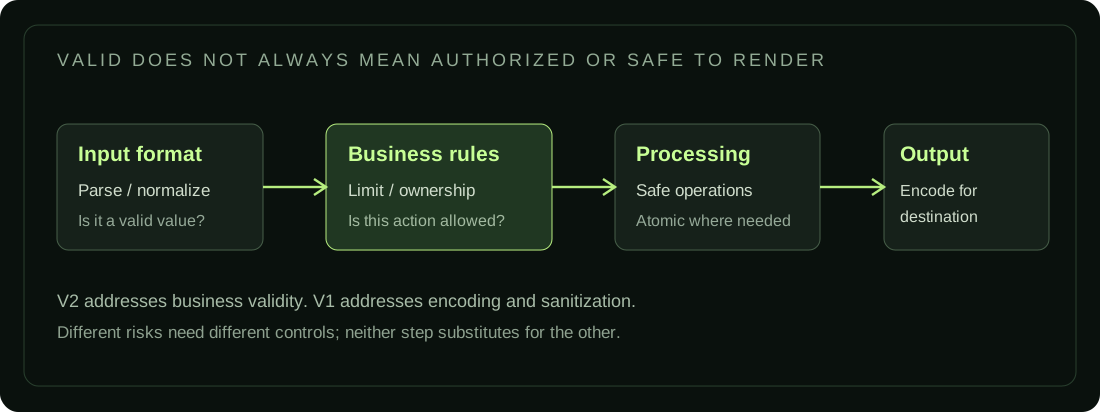
The V15 Secure Coding and Architecture chapter then connects this thinking to defensive coding, component risk and concurrency. It includes requirements for maintaining a software bill of materials (SBOM), documenting resource-intensive functionality, reducing exposure from risky components, preventing mass assignment and addressing race conditions.
The less obvious benefit is an improved conversation about behavior, not just vulnerabilities. A system may validate every individual request and still fail if two concurrent requests exploit the gap between checking a balance and changing it. This is precisely why atomic operations, resource limits and threat-aware architecture belong in security verification.
7. Real-time communications finally have a dedicated place
ASVS 5 introduces V17 WebRTC. This is especially relevant to video consultations, collaboration platforms and other real-time systems — but its requirements are not equally applicable to every application that merely embeds a communications SDK.
The chapter distinguishes responsibilities for TURN relays, media servers and signaling servers. For operators of their own infrastructure, the concerns include restricted relay destinations, protection against resource exhaustion, media transport integrity, malformed packets and signaling floods.
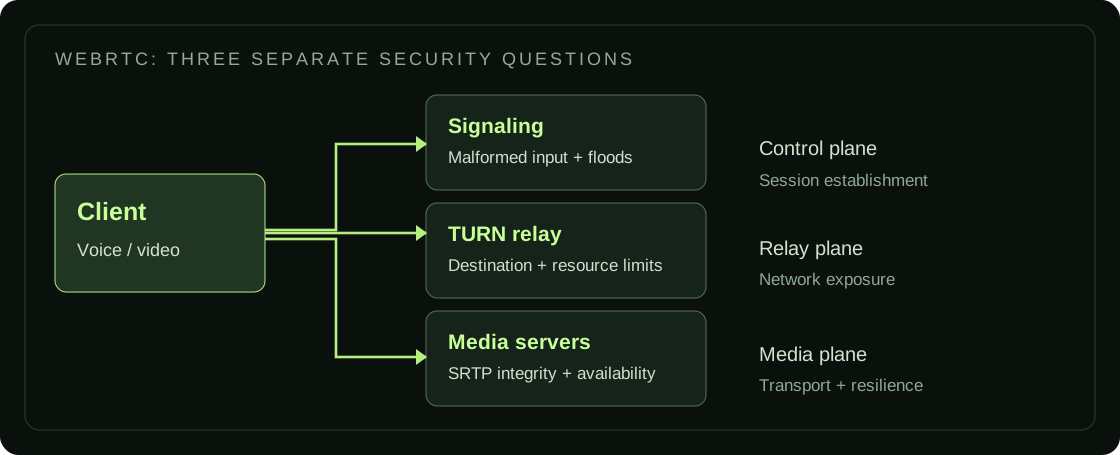
That separation is valuable. It stops teams from reducing “WebRTC security” to enabling encryption and calling the job done. Availability, resource consumption and control-plane exposure are part of the threat model as well.
The boundary matters: the official chapter explicitly limits which controls apply to product developers, communications platform operators and downstream applications using a provider's SDK. A good assessment follows those responsibilities rather than copying all controls into every questionnaire.
8. What organizations gain — and what they must not confuse
One structural change is easy to overlook: ASVS 5 no longer maintains direct mappings to NIST and Common Weakness Enumeration (CWE) in the standard's body. OWASP describes an intended route through its Common Requirement Enumeration (CRE) project, which could connect ASVS requirements to a wider ecosystem of references. This is a direction of integration, not evidence that every mapping is already complete or interchangeable.
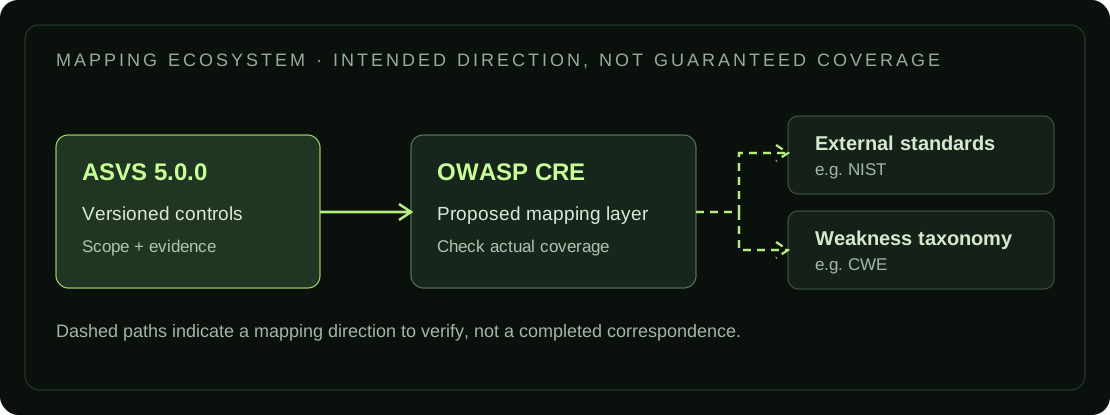
The benefit could be less fragile one-to-one mapping and clearer separation between an application requirement and a vulnerability taxonomy. The immediate migration cost is real, however: an organization relying on old ASVS-to-CWE or ASVS-to-NIST references must review its traceability and cannot assume those references carried forward.
Seen together, these changes create several practical opportunities:
| Change | Potential benefit | What still requires judgement |
|---|---|---|
| Outcome-focused requirements | More freedom to choose secure implementation patterns | Define pass or fail evidence, not generic assurances |
| Smaller Level 1 baseline | A realistic starting point for teams beginning verification | Select the target based on risk, not the easiest badge |
| Documented decisions | Trace business rules and trust boundaries into tests | Keep decisions current as architecture evolves |
| Dedicated frontend, token and OAuth domains | Clearer accountability across browser, identity and API components | Do not replace object-level authorization with token validation |
| Secure coding and architecture coverage | Earlier visibility of dependency, resource and concurrency risks | Link inventory, design, remediation and automated checks |
| WebRTC requirements | Dedicated treatment of real-time infrastructure | Apply controls to the components actually operated |
I would add three cautions.
First, ASVS is not a complete software delivery or infrastructure security framework. Its scope deliberately focuses on the application and relevant supporting controls. Supply-chain governance, delivery pipelines, host hardening, incident operations and organizational maturity need complementary practices.
Second, a requirement that can be tested is not necessarily a requirement that can be proved by a scanner. Design decisions, authorization semantics and resource ownership may demand architecture review, code inspection and contextual testing.
Third, ASVS does not automatically certify a product just because a team states a level. The assessment scope, evidence, independence, exclusions and the version of each requirement matter. Claims should be as precise as the underlying verification.
9. A credible migration path from 4.0.3 to 5.0.0
I would not start by replacing a column of requirement IDs. I would start by understanding what the existing assessment actually proves.
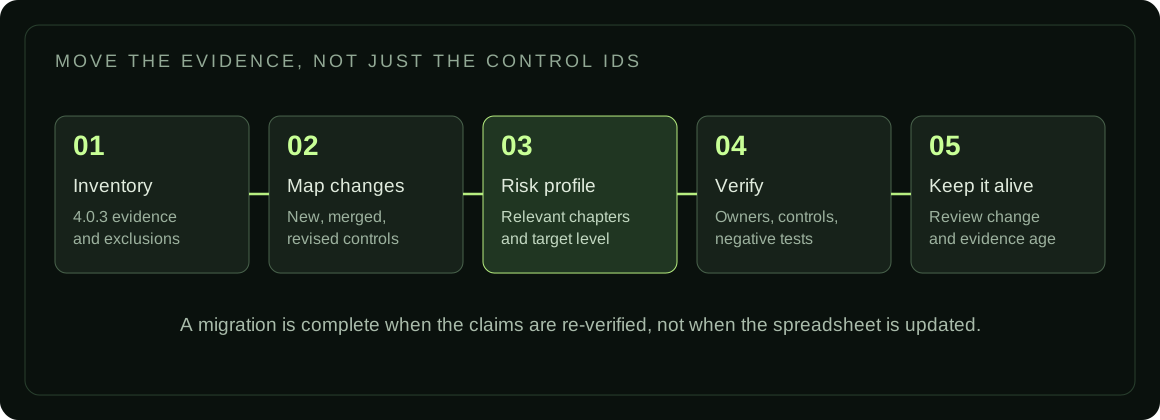
Phase 1 — Preserve the existing baseline
Export the current 4.0.3 findings, decisions, exclusions and proof. The fact that an item was marked “pass” in the old version is useful historical evidence, not a guarantee of conformance with the new one.
Phase 2 — Use the official mappings, then challenge assumptions
OWASP provides mappings between releases. Classify requirements as retained, changed, merged, removed or new. Investigate behavioral changes — especially around OAuth, tokens, browser boundaries and architecture — instead of treating mapped entries as automatically equivalent.
Phase 3 — Choose a justified application profile
Select applicable chapters and a defensible target level in light of data sensitivity, architecture, exposure and business consequences. Record exclusions such as the absence of WebRTC or a browser frontend. An application-specific profile is more honest than imposing irrelevant controls for numerical completeness.
Phase 4 — Attach evidence to controls
For each significant requirement, define the control owner, implementation reference, verification method, expected result and evidence date. For a denial rule, include a negative test. For a documented decision, include the approved design and the corresponding implementation check.
Phase 5 — Make reassessment repeatable
Automate what can be automated, but preserve explicit human review where context matters. Watch for changes in architecture, third-party components and business authorization rules. Security verification should travel with the application rather than exist only as a report before go-live.
10. Where this could go next — my reading, not an OWASP roadmap
The direction of ASVS 5 suggests several useful possibilities. These are inferences and proposals, not commitments announced by the project.
A requirement could become a traceable engineering object
The standard already offers structured exports such as CSV and JSON, and it recommends versioned identifiers like v5.0.0-10.3.1. My proposed next step is to link each applicable requirement to architecture decisions, code ownership, tests, exceptions and evidence. A stable trace becomes much more useful than an annual checklist.
Application-specific profiles could replace indiscriminate coverage targets
OWASP explicitly allows organizations to tailor their use of the standard while preserving requirement meaning and traceability. I see room for reusable profiles for browser applications, machine-to-machine APIs, high-sensitivity services and real-time platforms. Each profile would still need project-specific risk analysis; a template should accelerate judgement, not replace it.
Verification could become continuous without pretending it is fully automatic
CI/CD pipelines can exercise security regression tests, scan components and check certain configurations. Design reviews can validate trust assumptions and authorization models. A future assurance model could combine both, showing which claims are automated, which require review and which have become stale after a system change.
AI could support interpretation, provided it never invents evidence
An AI assistant could help explain requirements, draft abuse cases, identify missing evidence and compare implementation notes with expected controls. But I would not allow it to turn plausible language into a “pass.” Every conclusion needs provenance, an explicit verification method and a human accountable for decisions with material risk.
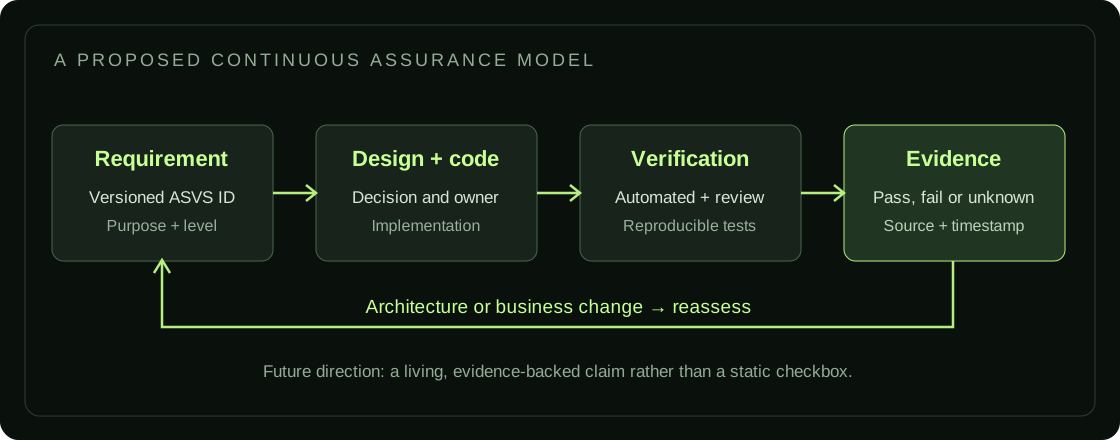
The genuinely important shift would be this: from static compliance statements to living, versioned claims about how an application resists specific failures.
My conclusion
I welcome the ambition of ASVS 5.0. Not because it makes security simple — it does not — but because it helps us be more precise about difficult things.
It pushes us to separate a browser from an API, a token from an authorization decision, a technical mechanism from the outcome it should deliver, and a completed test from an enduring security claim.
The mistake would be to adopt 5.0 as a bigger checklist, or to select a level solely because it is easier to achieve. The opportunity is to make security architecture more explainable, implementation more deliberate and verification more credible.
For me, that is what progress in application security should look like: fewer assumptions, better evidence and less friction for teams that want to build the right thing.
Primary sources and scope of this analysis
- OWASP ASVS official website and release date — confirms 30 May 2025 and the stable 5.0.0 release.
- Official ASVS 5.0.0 release — versioned historical baseline.
- ASVS 5.0.0 — Changes Compared to v4.x — philosophy, restructuring, counts and levels.
- ASVS 5.0.0 — Scope, levels and application — official guidance on applicability and verification.
- ASVS 5.0.0 — OAuth and OIDC, Self-contained Tokens, Web Frontend Security, Secure Coding and Architecture, and WebRTC — examples checked against the tagged release, rather than the evolving main branch.
The diagrams illustrate architectural reasoning, not a complete implementation blueprint. All proposed adoption and future directions in this article are my own interpretation. They should be validated against the actual application, its threat model and the versioned normative text before being used as assessment criteria.